Frame height, clearance and what actually fits under a bed
The number nobody advertises decides how the room works: how much floor comes back, how easy the bed is to get out of, and whether the boxes you already own will slide underneath.
Why the height of a frame is the number that decides the room, not the mattress
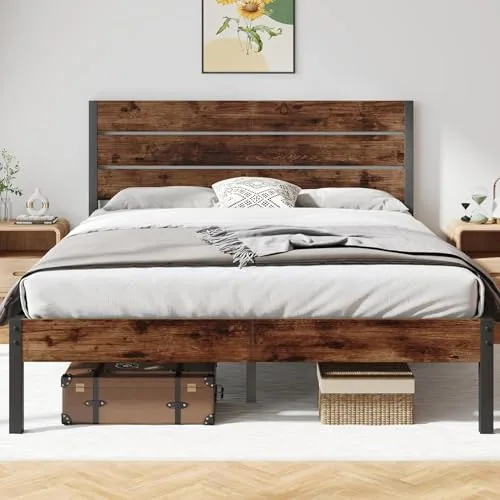
A mattress determines where you sleep. The frame determines how much of the room sits below it.
That difference matters in a small bedroom. A mattress may be 10 or 12 inches thick, but its thickness does not tell you if a storage box will fit underneath. The useful measurement is the distance from the floor to the lowest solid part of the frame. This is the clearance. It may be much smaller than the mattress thickness, or much larger.
The overall bed height can also give you the wrong impression. A tall headboard may make the bed look substantial while leaving only a modest gap underneath. A lower headboard may sit above a deeper open area. Separate these three measurements:
- Floor to the top of the mattress
- Floor to the top of the frame
- Floor to the underside of the frame
The third measurement controls what can go below the bed. The first two help you judge how high the bed will feel and how it will sit near windows, shelves, wall art, and other furniture.
A higher frame can free up floor area without requiring another piece of furniture. It may leave room for seasonal clothing, spare bedding, luggage, or cleaning supplies. It can also make the floor around the bed feel less crowded. That only helps when the space is high enough for the items you want to store and accessible enough for regular use.
A lower frame may be easier to get in and out of. It may suit a room where you want the bed to feel visually settled instead of raised. The tradeoff is less usable room beneath it. A shallow gap may collect dust without accepting a useful container. That leaves a space that is difficult to clean and too narrow to organize.
We describe our range across five departments: King, Queen, Full, Twin, and Nightstands. There are 46 bed frames and bedside pieces in total. Listed prices run from $69.99 to $184.99. These figures help you compare the range, but they do not tell you the clearance beneath a particular frame. Use the measurements in the product details for that frame.
Mattress size affects the width and length of the sleeping surface. It does not tell you if a box will slide under the center, if a drawer can open beside a wall, or if a vacuum attachment can reach the far side. If under-bed space matters, begin with the frame height and clearance. Consider the mattress after that.
Your everyday habits matter too. Do you need to reach storage each morning? Do you want to put something away for several months? Are you trying to keep the floor clear, or do you need a place for spare linens? The same clearance may work well for one purpose and poorly for another.
We have frames with several practical features across the range. Forty-three have a headboard. Thirty-eight carry storage. Twenty-eight have a built-in charging station, and 28 have LED lighting. These features can reduce the need for furniture around the bed, but they do not replace measuring the area beneath it.
Sleep conditions also deserve attention when you plan the room. The Centers for Disease Control and Prevention describes a helpful bedroom goal as "Keeping your bedroom quiet, relaxing, and at a cool temperature." A frame height will not control all of those conditions, but its position can affect how the room is arranged. Leave enough space to move around the bed, reach nearby items, and keep the sleeping area comfortable.
The Centers for Disease Control and Prevention also states that "Quality sleep means you are getting uninterrupted and refreshing sleep." Use the frame’s height and layout as part of the room plan, not as the only consideration.
How clearance is measured and where the useful figures sit in this range
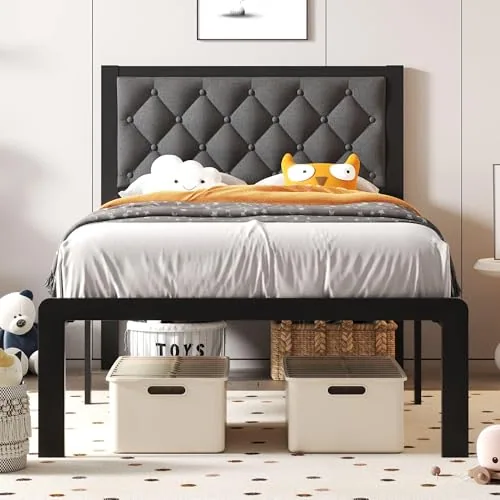
Clearance is measured vertically from the floor to the lowest point that blocks the space under the bed. That point may be the underside of a side rail, a support rail, a drawer base, or another structural part. Do not measure from the floor to the top of the platform. Do not measure to the mattress.
A frame may have a generous opening at the side and less space toward the center. Support legs or center rails can divide the area into narrower sections. A container that fits at the edge may not pass between the supports. Before ordering, find the lowest obstruction and the narrowest route to the storage area.
The word “clearance” can refer to more than one measurement. Some product details describe the distance from the floor to the frame. Others describe the height of an open storage area. Read the label beside the number. If the reference point is not clear, treat the figure as something to confirm before planning around it.
Use this table as a planning guide only. The bands describe the kind of item that may fit under a bed with that much open vertical space. They are not measurements for every FLUEST frame. Container height, wheels, handles, floor trim, and support rails can change the result.
| Open clearance beneath the frame | What may fit underneath | Practical limit to watch |
|---|---|---|
| About 4 to 6 inches | Flat fabric bags, thin shoe storage, folded items in shallow cases | Rigid boxes may be too tall. Handles can keep a container from sliding fully underneath |
| About 7 to 9 inches | Low lidded bins, compact shoe boxes, folded linens in soft-sided containers | Measure the container at its tallest point, including the lid |
| About 10 to 12 inches | Medium storage boxes, bedding bags, smaller luggage | Center supports may reduce usable width and make access slower |
| About 13 to 15 inches | Taller boxes, larger bedding containers, some suitcases | Check the route into the space, not only the final height |
| More than 15 inches | Larger boxes and bulkier items, subject to the frame layout | Items may fit vertically but still be difficult to pull out or clean around |
These bands help you decide what to measure at home. They do not mean that a container with an exact matching height will slide in. Leave room for movement. A tight fit can become impractical if the floor is uneven, the container flexes, or you need to pull it out by hand.
Clearance becomes more useful when you compare it with items you already own. Measure your largest storage box, the vacuum head, and the suitcase you use most. Measure new containers before selecting them. Write down height and width. A box that is low enough may still be too wide for the gap between the legs.
Under-bed storage: drawers versus open clearance versus boxes
Under-bed storage usually falls into three arrangements: integrated drawers, open clearance, or separate boxes placed in an open area. Each solves a different storage problem.
Drawers provide a defined place for belongings. They keep contents together and make it easier to divide clothing, bedding, or accessories by category. You pull the drawer toward you instead of reaching under the frame. That makes drawers useful for items you use often.
The main question is the room around the bed. A drawer needs a clear path to open. A wall, nightstand, radiator, desk, or another bed can block that path. You also need enough room in front of the drawer to stand and pull it out. Measure the full opening area, not only the gap between the side rails.
Drawers can limit the shape of what you store. A built-in drawer has a fixed width and depth. Large blankets may need to be folded in a particular way. Suitcases may not fit. Check the product details for the storage layout and dimensions when those details are provided.
Open clearance is more flexible. You can choose a box after the frame is in place, change the contents later, or leave part of the area open for cleaning. This arrangement may suit changing storage needs. It also leaves the floor beneath the bed visible, making the area easier to inspect.
The drawback is that open space needs more organization. Items placed directly on the floor can gather dust and may be harder to pull out. A fabric bag may be easier to handle than a rigid bin, but it may not protect its contents in the same way. A lidded box can help keep out dust, though the lid adds height and may slow access.
Separate boxes provide control over capacity. You can use one large container, several smaller ones, or a combination arranged around the supports. Smaller boxes may be easier to lift. Larger boxes may use the space more efficiently but can become heavy when full. If you store books or other dense items, consider their weight before choosing a large container.
Use this comparison when deciding which arrangement suits your room:
What a headboard with shelves changes about a small room
A headboard with shelves moves storage into the wall area behind the bed. In a small room, that may reduce the need for a separate bedside table or another shelf. It gives everyday items a defined location near the pillow, where they are easy to reach.
The tradeoff is depth. Shelves project into the room, even when they sit above the mattress. Check the distance between the headboard and the opposite wall, desk, or doorway. Consider the walking route beside the bed as well. A shelf is useful only when it does not make the path feel cramped.
Look at what you plan to keep there. A small book, glasses, or a phone may need only a shallow shelf. A lamp, alarm clock, or taller object needs more vertical room. Do not assume that every shelf suits every object. Use the product’s stated dimensions when they are provided.
A headboard can change the visual balance of a room. Open shelves show their contents. That may make the area feel personal and convenient, but it can also make a small room look busy. Keeping regularly used items on the shelves can help the bed area feel calmer.
Charging and lighting are separate features from shelving. Twenty-eight frames in our range have a built-in charging station, and 28 have LED lighting. If a frame includes one of these features, read the product details for its placement and layout. Do not assume the charging point or light will be on your preferred side.
Cable routing needs a quick check. A cord running from the headboard to the wall can affect the gap behind the bed. Leave enough room for the cable without bending it sharply or trapping it against the wall. If the bed must sit near a window or outlet, measure that position before deciding.
Headboards also add height above the mattress. Compare the top of the headboard with windows, shelves, pictures, and ceiling fixtures. A taller headboard may provide useful storage, but it can cover part of a window or make a wall-mounted item harder to access.
Our range includes 43 frames and bedside pieces with a headboard. The presence of a headboard alone does not confirm shelves, charging, lighting, or another feature. Treat each feature as a separate detail. The product details for the frame you are considering are the right place to confirm its layout.
Noise: where squeaks come from in a metal frame and what stops them
A squeak usually comes from movement at a contact point. On a metal frame, that may be a joint, fastener, support rail, leg, or place where two parts touch as the frame carries weight. The sound can appear when you turn over, sit on the edge, or shift the frame slightly across the floor.
Loose hardware is one possible cause. Fasteners can settle after assembly, especially if the frame has been moved or used for a while. Review the assembly instructions and tighten connections as directed. Do not force a fastener beyond the instructions or alter the frame.
An uneven floor can also make a frame rock. A small movement at one leg can travel through the structure and create noise at another connection. Place the frame in its intended position and test it gently before loading the mattress. If it rocks, check the floor and the leg contact points. Do not insert improvised objects into a joint or change the support arrangement.
Contact between metal parts can create friction. Dust or grit at a connection may add to the movement. Keeping the area clean can help. If the assembly instructions specify a suitable treatment for a joint, follow those instructions. Do not apply a product unless the care or assembly guidance supports it.
The mattress and foundation can also contribute to sound. A mattress that shifts against a frame, or a foundation that moves on the platform, may sound like a frame squeak. Test the bed in stages. First press the bare frame in different places. Then add the foundation or mattress and repeat. This can help identify where the sound begins.
The floor surface matters too. A frame may sound different on a hard floor, rug, or uneven surface. A rug may soften movement, but it will not correct a loose connection or unstable leg. Make sure the frame sits fully on the intended surface before deciding that the sound comes from the metal.
We have 34 all-metal frames in the range, and the same basic inspection applies to any frame with metal supports. Upholstered construction may cover some connection points, but covering does not remove the need for careful assembly. Use the supplied instructions for the model you choose.
Avoid adding unapproved parts, drilling into the frame, or changing the support layout to stop a noise. These changes can affect how the frame carries weight. A quiet bed begins with a level position, complete assembly, and properly seated connections.
A practical measuring routine before ordering
Start with the room, not the product details. Measure the wall where the headboard will sit, the walking paths, and the distance to nearby furniture. Record the tightest points. A frame can fit within the room’s overall dimensions and still block a drawer, doorway, or closet.
Next, measure the existing mattress if you plan to use it. Confirm its width and length against the frame department you are considering: King, Queen, Full, or Twin. Do not use mattress thickness as a substitute for the frame’s height information.
Identify your clearance goal. Write down the item you want to store under the bed and measure its tallest point. Include a lid, wheels, handles, and anything else that sticks out. Measure width and depth as well. If you plan to use several boxes, measure each type.
Use painter’s tape on the floor to mark the approximate footprint of the frame. This gives you a quick view of the room left on each side. Mark the drawer opening too, if the frame includes drawers. Picture the drawer fully open within the taped layout and check for nearby furniture.
For an open-clearance frame, measure the route from the side of the bed to the storage area. Check the narrowest gap between legs or supports. If that figure does not appear in the product details, do not assume the entire space beneath the mattress is open.
Make a second list for height. Record:
1. Floor to the top of the mattress 2. Floor to the top of the frame 3. Floor to the underside of the frame 4. Floor to the top of nearby furniture 5. Floor to the top of a window sill or wall fixture
This list helps you assess comfort and fit. The third number controls under-bed storage. The first number helps you judge how high the bed will feel. The other measurements show potential conflicts around the room.
If the frame includes a headboard, measure from the floor to the available wall height. Mark the headboard height on the wall with removable tape if you have it. Check shelves, outlets, windows, and anything mounted above the bed. If the frame includes LED lighting or a built-in charging station, plan its position in relation to the outlet and cable path.
Review the frame’s stated weight capacity when that figure is provided. In our range, capacity is stated for 16 frames, and the highest stated figure is 1000 lb. Compare the stated capacity with the people and bedding that will use the frame. Do not treat the figure as a guide to the weight of items stored underneath.
Finally, compare your notes with the exact product details. Our range includes black, grey, beige, white, retro brown, rustic grey, and antique white. Color can help the frame work with the room, but it should come after the fit, clearance, layout, and feature checks.
Before placing an order, answer five simple questions:
- Will the frame fit the room with usable walking space?
- Is the floor-to-frame clearance high enough for the item you want below it?
- Can drawers or boxes open without moving other furniture?
- Does the headboard fit the wall and leave room for shelves, lighting, or charging?
- Do the stated dimensions and capacity suit your intended use?
Sources
- About Sleep, Centers for Disease Control and Prevention. Read 14 August 2026. How much sleep each age group needs, what counts as good quality sleep, and the habits that affect it.
Nothing on this page is medical advice. Where a public authority is quoted, the quotation is word for word and the link goes to the page we read.